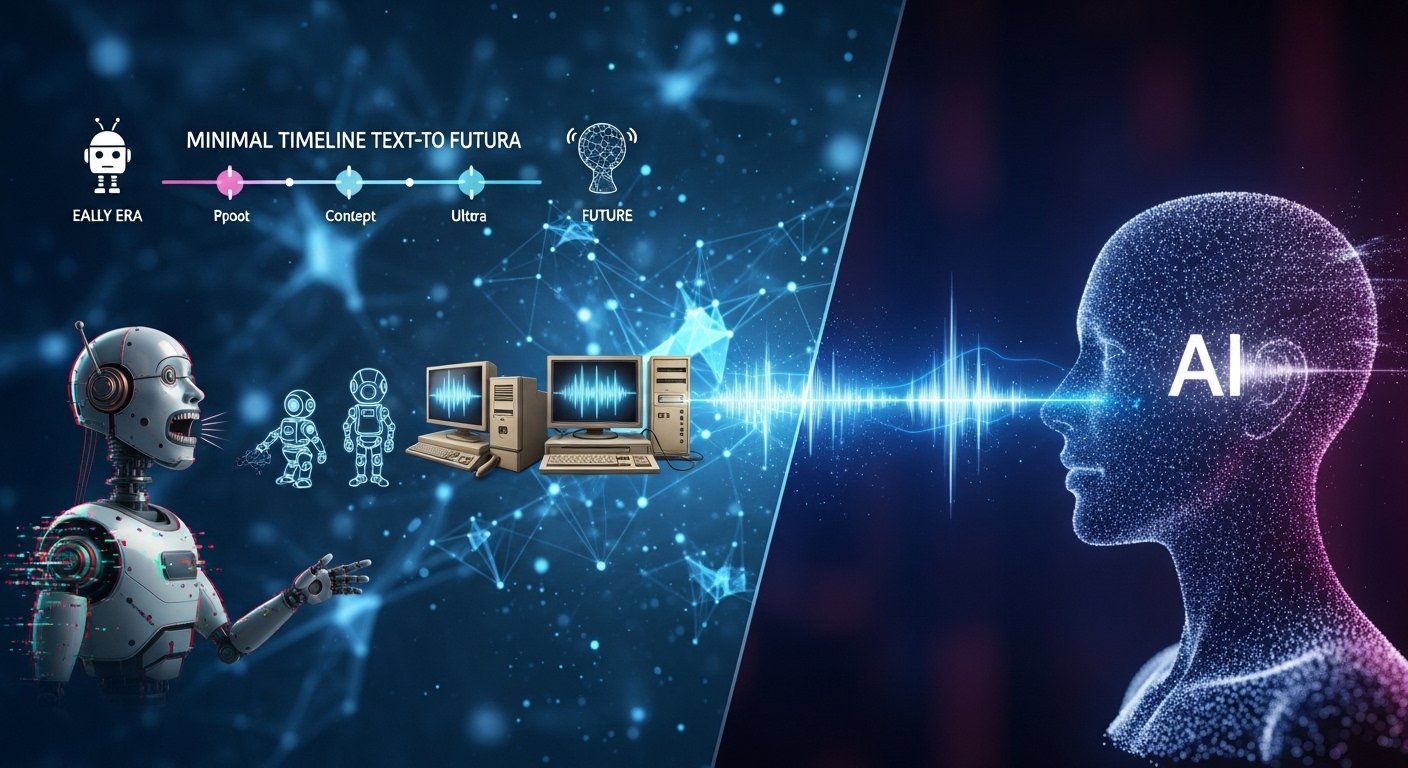
The History of Text-to-Speech: From Robots to Natural Voices
Introduction
Text-to-Speech (TTS) technology has come a long way from its early days of robotic, monotone voices to today’s highly natural and expressive AI-generated speech. What once sounded mechanical and artificial now closely resembles human conversation, making it an essential part of modern digital experiences.
But how did this transformation happen? In this blog post, we’ll explore the history of Text-to-Speech, tracing its journey from early experimental machines to the advanced neural voices we use today.
The Early Beginnings of Speech Synthesis
The concept of machines producing human-like speech dates back centuries. Long before computers existed, inventors were fascinated by the idea of replicating the human voice.
In the 18th century, Wolfgang von Kempelen created a mechanical speech machine that could produce simple sounds using bellows and pipes. Although primitive, it marked one of the earliest attempts at artificial speech.
Later, in the 1930s, Bell Labs introduced the Voder (Voice Operating Demonstrator). It was one of the first electronic speech synthesizers, capable of generating human-like sounds using a keyboard and foot pedals. However, it required skilled operators and was far from practical for everyday use.
The Rise of Computer-Based TTS (1950s–1970s)
With the development of computers in the mid-20th century, researchers began exploring digital speech synthesis.
Key Developments:
Early computers could generate simple tones and phonemes
Speech output was highly robotic and difficult to understand
Systems required large hardware and were not user-friendly
One notable breakthrough came in the 1960s, when researchers at IBM developed one of the first computer systems capable of reading text aloud. While impressive for its time, the voice sounded unnatural and lacked proper intonation.
Despite these limitations, these early systems laid the foundation for modern TTS technology.
The Era of Rule-Based Systems (1970s–1990s)
During this period, TTS technology improved significantly with the introduction of rule-based synthesis.
How It Worked:
Text was analyzed using linguistic rules
Pronunciation was generated based on predefined patterns
Speech was produced using synthetic models
Although voices were still robotic, they became more intelligible and consistent.
Important Milestones:
Development of text analysis algorithms
Improved phoneme generation
Introduction of commercial TTS systems
By the 1980s and 1990s, TTS started appearing in consumer products such as:
Early personal computers
Assistive devices for visually impaired users
Educational software
This era made TTS more accessible, but the lack of natural expression remained a major challenge.
The Introduction of Concatenative Synthesis (1990s–2000s)
A major leap forward came with concatenative synthesis, a technique that used recorded human speech instead of purely synthetic sounds.
Key Features:
Speech was created by stitching together small audio clips
Voices sounded more natural than previous methods
Better pronunciation and fluency
This approach significantly improved audio quality, making TTS more pleasant to listen to.
Real-World Impact:
GPS navigation systems began using voice directions
Automated phone systems became more common
Audiobooks started incorporating synthetic narration
However, concatenative systems had limitations:
Limited flexibility
Difficulty handling new words or emotions
Large storage requirements
The Shift to Statistical and Parametric Models
To overcome the limitations of concatenative synthesis, researchers introduced parametric TTS models.
How They Worked:
Used mathematical models to generate speech
Required less storage
Allowed more flexibility in voice generation
While these systems were more efficient, they often sacrificed naturalness, resulting in slightly robotic-sounding voices.
Still, they played a crucial role in advancing TTS technology and preparing the groundwork for the next big revolution.
The AI Revolution: Neural Text-to-Speech (2010s–Present)
The biggest breakthrough in TTS history came with the rise of artificial intelligence and deep learning.
Neural TTS Explained:
Neural TTS systems use deep neural networks to generate speech that closely mimics human voices. Instead of stitching clips or following rigid rules, these systems learn from massive datasets of human speech.
Key Innovations:
End-to-end speech generation
Natural intonation and rhythm
Emotional expression
Real-time voice synthesis
Technologies like WaveNet and Tacotron transformed the industry, making TTS voices almost indistinguishable from real human speech.
Modern Applications of TTS
Today, Text-to-Speech is everywhere. Some of its most common uses include:
1. Virtual Assistants
Devices like smartphones and smart speakers use TTS to interact with users.
2. Accessibility Tools
TTS helps visually impaired users access digital content easily.
3. Content Creation
Creators use AI voices for videos, podcasts, and narration.
4. Navigation Systems
GPS apps provide real-time voice directions.
5. Customer Support
Businesses use automated voice systems for efficient communication.
Why Modern TTS Sounds So Real
Modern TTS systems sound natural because they focus on:
Prosody (rhythm and intonation)
Context understanding
Emotion simulation
Voice personalization
AI models can now adjust tone, pitch, and speed to match different situations, making interactions more human-like.
Challenges in TTS Development
Despite its progress, TTS still faces challenges:
❌ Emotional Depth
While improving, AI still struggles with deep emotional expression.
❌ Language Nuances
Accents, dialects, and cultural variations can be difficult to replicate accurately.
❌ Ethical Concerns
Voice cloning raises concerns about misuse and authenticity.
The Future of Text-to-Speech
The future of TTS is incredibly exciting. Upcoming advancements may include:
🧠 Fully human-like conversational AI
🎭 Advanced emotional expression
🗣️ Personalized voice cloning
🌐 Seamless multilingual communication
As technology continues to evolve, TTS will become even more integrated into everyday life.
Conclusion
The journey of Text-to-Speech technology—from mechanical machines to advanced AI voices—is a remarkable example of technological progress. What started as experimental devices producing robotic sounds has evolved into sophisticated systems capable of delivering natural, expressive speech.
Today, TTS is not just a tool—it’s a powerful technology shaping how we communicate, learn, and interact with the digital world. As innovation continues, the line between human and machine speech will become even more blurred.
Understanding the history of TTS helps us appreciate how far we’ve come—and how exciting the future truly is.
FAQs
1. When was Text-to-Speech invented?
The concept dates back to the 18th century, but modern TTS developed in the 20th century.
2. What made TTS more natural?
The introduction of AI and neural networks significantly improved voice quality.
3. Is TTS used today?
Yes, it is widely used in smartphones, apps, and digital platforms.
4. What is the future of TTS?
More human-like voices, emotional speech, and personalized AI voices.
Final Thought: The evolution of Text-to-Speech shows how technology can transform even the most complex human abilities—like speech—into something machines can replicate with stunning accuracy.